
If you’ve spent any time researching Specialist Disability Accommodation (SDA), you’ve probably come across the term Appendix H, and you’re not alone in wondering what it actually means.
Appendix H is one of the most important changes in SDA funding in recent years, and for the right investor, it can represent one of the most reliable occupancy setups in the entire NDIS property space.
This article explains Appendix H in plain English, why it matters, and why it’s often considered the safest structure for long-term SDA investors even in a sector that will always carry higher risk than traditional property investing.
What Is Appendix H?
A part of the NDIS SDA Pricing Arrangements, introduced to allow SDA participants to live with a loved one who is not SDA-funded.
Traditionally, SDA models were structured like this:
- One participant living alone, or
- Multiple SDA-funded participants sharing a home
But many participants don’t want to live with strangers. They want to live with their:
- spouse or partner
- parent
- sibling
- adult child
- long-term support person
Appendix H makes that possible.
It adjusts the SDA funding so a participant can live in a compliant SDA home while sharing it with a non-funded family member or loved one.
This is a huge step forward for participant choice, and a major opportunity for investors seeking stability.
Why Appendix H Matters for Participants
At its core, it is about something simple: keeping people together.
For many participants with high physical support needs, moving into SDA is already a major life transition. Being able to do that while living with someone familiar can be life-changing.
Appendix H supports:
- stronger emotional wellbeing
- better long-term housing stability
- improved independence
- less disruption for families
In many cases, participants will wait longer or refuse unsuitable options until they find an Appendix H-compatible home. Because, once they finally secure the right setup, they are far less likely to move again.
That stability matters.
Why Appendix H Is So Attractive for Investors
Now let’s talk about the investor side. This is where this arrangement becomes one of the most reliable models available in SDA.
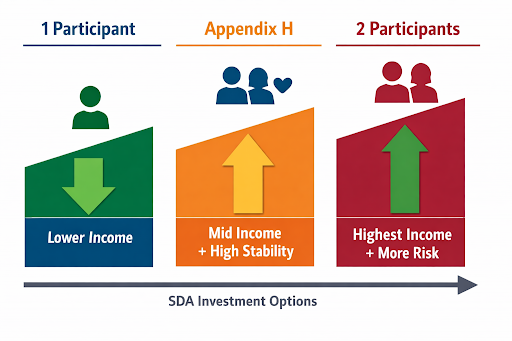
1. Better income than a single participant
Appendix H pays more than a standard single-occupant SDA arrangement.
It won’t match the maximum return of two SDA-funded tenants, but it offers a strong middle ground:
- higher than one
- lower than two
- significantly more stable than chasing two
For many investors, it’s the best risk-adjusted balance in the sector.
2. Reduced “housemate compatibility” risk
This is a big one.
A lot of investors aim for two participants because it looks better on paper.
But the reality is:
Two participants means double the complexity.
If they don’t get along, if support needs clash, or if one exits unexpectedly, the income can drop fast.
Appendix H removes much of that risk because the participant is living with someone they already trust, a partner or family member.
That dramatically improves the likelihood of long-term occupancy.
3. Vacancy risk is lower
SDA is not a low-risk investment class.
Vacancy is real, and some homes sit empty simply because the right match hasn’t been found.
Appendix H can reduce that exposure because the participant doesn’t need a second SDA-funded tenant to make the arrangement work.
Instead, the household is already formed: Participant plus loved one, which creates more consistent demand for the right properties.
4. Banks tend to view it more favourably
While every lender is different, Appendix H setups are often seen as more stable than speculative multi-tenant models, and can directly impact the commercial valuation.
Why?
Because the occupancy isn’t dependent on finding two funded participants at the same time.
From a financing perspective, a stable household arrangement can be easier to support than a revolving share-house model.
Not Every SDA Property Qualifies
Here’s the catch. And it’s important:
Not all SDA homes can operate under Appendix H.
General requirements:
- a multi-bedroom compliant SDA dwelling
- a participant with approved SDA funding
- the correct household structure
- appropriate provider agreements
So when a participant specifically needs Appendix H, their options can be limited.
That scarcity is part of why Appendix H properties can be so tightly held once occupied.
Still High Risk. Just the Safest Version of It
Let’s be clear:
SDA will always be a higher-risk space compared to standard residential property.
It’s tied to:
- NDIA policy
- participant plan approvals
- provider performance
- specialist demand in specific locations
If you’re not comfortable with complexity, SDA isn’t the right asset class.
But if you are comfortable with SDA risk and want the most stable structure available, Appendix H is widely considered one of the safest setups within the sector.
It’s not risk-free.
It’s risk-mitigated.
Example: Appendix H in Practice
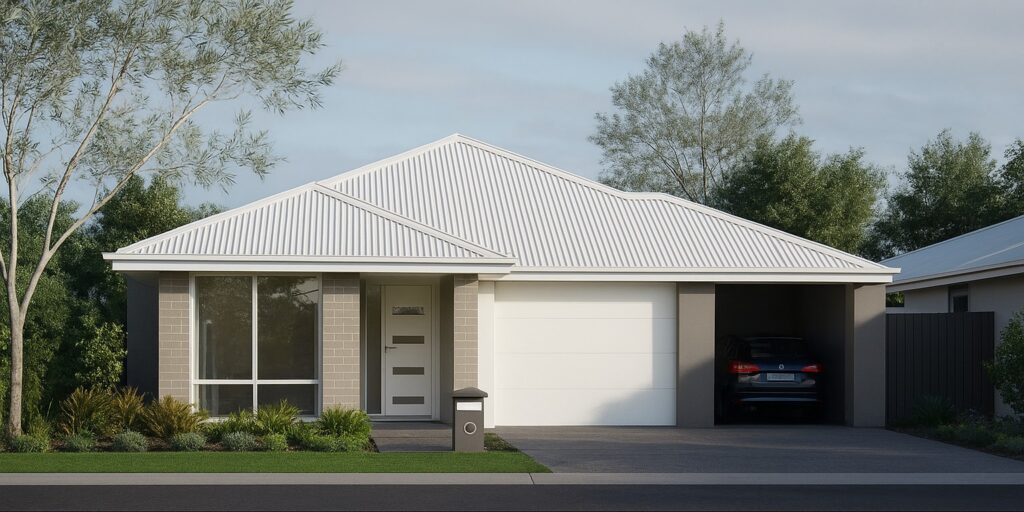
A recent example of this structure can be seen in this High Physical Support SDA home in Greenbank, Brisbane.
This property was sold with an established SDA arrangement already in place, generating approximately $118,000 per year under an Appendix H-style occupancy structure.
The key point wasn’t just the income, it was the reliability.
The participant was living in a long-term arrangement with loved ones, creating a stable household setup that investors increasingly value over higher-yield but higher-volatility share models.
Final Thoughts
Appendix H is one of the most important developments in SDA investing because it supports what the NDIS is meant to deliver:
- stable housing
- real choice
- long-term independence
- family connection
And for investors, it offers something rare in SDA:
a more reliable setup with strong returns and reduced vacancy risk.
If you’re exploring SDA as an investment pathway, this is absolutely a model worth understanding. Not because it pays the most, but because it often performs best over the long term.
Written by Asle Kommedal
Topstone Property Invest